
Gyan vigyan sangam
" पुरातन युग में ज्ञान-विज्ञान का संगम "
.png)
Menu

-
contributor: Harvey Cushing
-
Time Period: Late 19th century onwards
-
Location: America
-
Description: Brain surgery refers to the medical procedure involving the manipulation of brain tissues to treat neurological disorders, brain tumors, traumatic brain injuries, and other conditions. It involves intricate techniques and specialized tools to access and operate within the delicate structures of the brain.
-
Conclusion: Sushrut's pioneering work in ancient India laid the foundation for the development of medical sciences and surgical techniques worldwide, including those related to brain surgery. His contributions continue to be recognized and appreciated in medicine worldwide, highlighting the enduring significance of ancient wisdom in modern healthcare practices. We can say that modern science is alive through the contributions of ancient scientists.
-
Modern Science: Brain Surgery
%20used%20in%20skull%20surgeries%20by%20Maharshi%20Sushrut.png)
-
Ancient science: Karnashastra
-
Inventor: Maharshi Sushrut (Father of Medical Sciences and Surgery)
-
Time Period: Around 6th century BCE
-
Location: Bharatvarsh
-
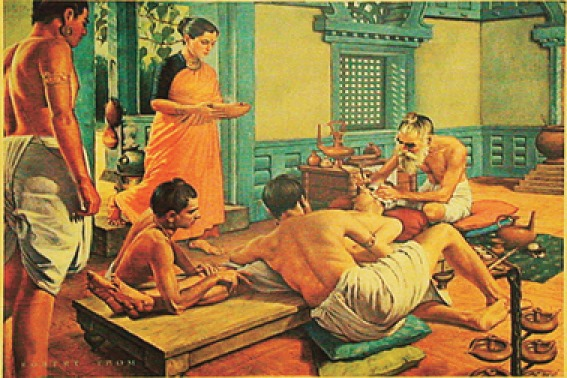
Description: Sushrut, an ancient Indian sage and physician, is credited with pioneering early techniques of surgery, including procedures related to the brain. In his treatise "Sushrut Samhita," he described various surgical techniques and tools used in his time, including those for cranial surgeries.
-
Evidence:
Sushruta Samhita, Uttaratantra, Chapter 1, Verse 22:
चूर्णाः शिरसि भिद्यन्ते ये वा भिद्यन्ति केचन।
तेभ्यः कुर्याद्भिदान्यां कालकर्मात्मकान्यथा॥
Translation: "When bones of the head are fractured or when some of them are perforated, the physician should cause them to be trepanned at suitable places and in suitable ways according to the rules of time and causes."
Meaning: This verse from the Sushrut Samhita advises surgeons on how to treat head injuries and fractures by performing trepanation, a form of cranial surgery where a hole is drilled or scraped into the skull to relieve pressure or remove bone fragments.
Here are a few more verses from the Sushrut Samhita that discuss the brain treatment:
1. Sushrut Samhita, Sutrasthana, Chapter 8, Verse 19:
कपालस्थापने षड्भिः शस्त्रैः क्रियते क्रिया।
तेषां स्थानानि कार्याणि विज्ञेयानि च बुद्धिमान्॥
Translation: To treat fractures of the skull, six types of surgical instruments (Shastra) are employed. The wise should understand their specific positions and applications.
2. Sushrut Samhita, Sutrasthana, Chapter 6, Verse 31:
अर्धविभ्रंशहेतोश्च शस्त्रकर्म परं मतम्।
स्रावणीयं च मूर्ध्नः स्रावेणोपधमेत् क्रमात्॥
Translation: Surgery is considered the best treatment for half-head injuries, followed by procedures to drain excess fluids.
3. Sushrut Samhita, chikitsa sthana, Chapter 6, Verse 16:
मूर्च्छा शोणितसंरुद्धा तिर्यगूर्ध्वं तथाऽधवा।
शूलसंरुद्धकर्णाश्च स्रावेणोपशमं ययुः॥
Translation: Unconsciousness due to the obstruction of blood flow in the head can be treated by bloodletting, which helps relieve pain and other symptoms.
4. Sushrut Samhita, Uttartantra, Chapter 21, Verse 41:
मस्तिष्कं दशवाराणि संस्कारा मन्त्रदूतकैः।
Translation: The brain should be treated with medicines and mantras for ten days.
These verses provide insights into the ancient understanding and treatment of brain-related issues in Ayurved, as described in the Sushrut Samhita.
Connection between Modern and Ancient Concepts: In modern times, the concept of brain surgery can trace its roots back to the ancient techniques described by Sushrut. This reflects the greatness of ancient medical scientists. Maharshi Sushrut’s contributions to the medical sciences and surgery pioneer modern health science. This shows that the ancients were very efficiently skilled and educated to perform such complex surgeries.
Maharshi Sushrut performing skull surgery

Harvey Cushing

Surgical Instruments (Shastra) used in skull surgeries by Maharshi Sushrut
4300 year old human skull with successful skull surgery found at a Harappan site

